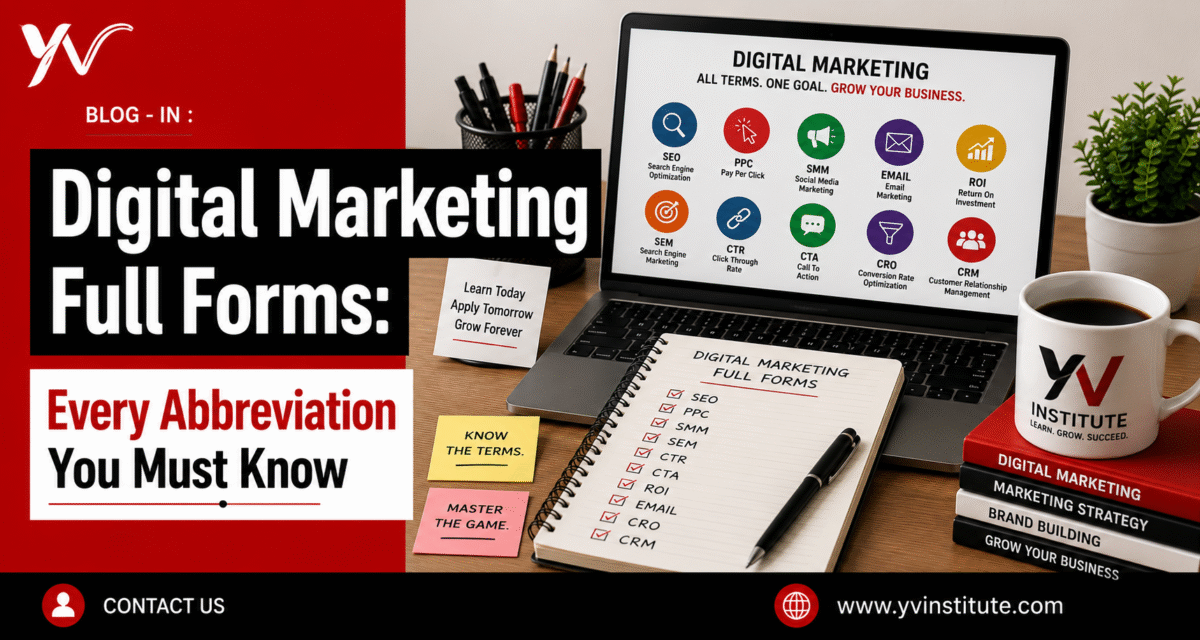
Ever sat in a meeting and nodded along while someone rattled off CTR, ROAS, SEM, CPA and had no clue what half of it meant? You are not alone. Digital marketing runs on acronyms, and if you do not know what they stand for, you cannot use them strategically. This guide covers every important digital marketing full form with plain explanations, no fluff.
Why Knowing Digital Marketing Full Forms Actually Matters
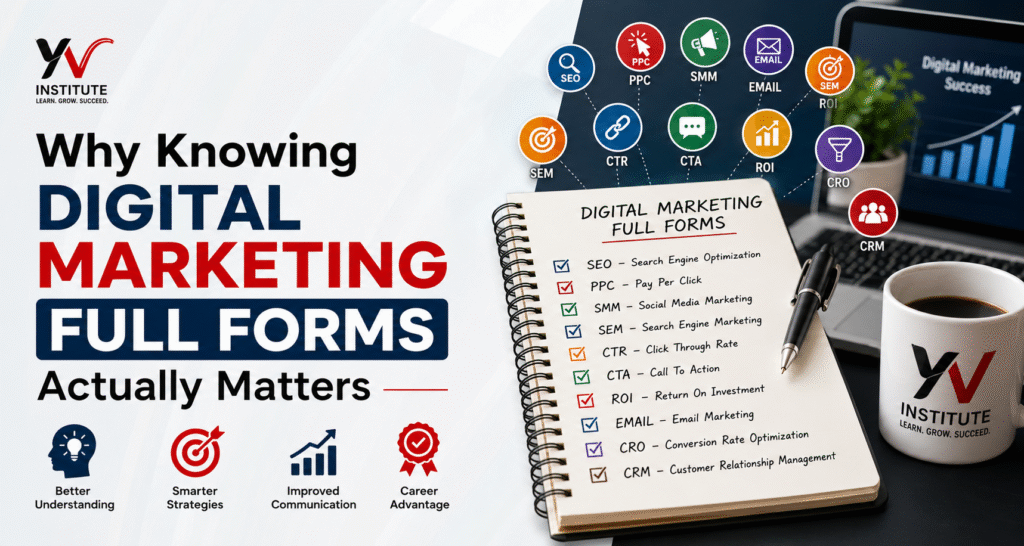
Digital marketing is one of the fastest-moving industries on the planet. Strategies shift, platforms evolve, and new tools pop up every quarter. But the abbreviations stick around and they are the backbone of how marketers communicate with each other, with clients, and with leadership. When you do not know what CPC or SERP means, you cannot interpret reports. You cannot have a meaningful conversation with your agency. You cannot make smart decisions with your ad budget. Knowing your full forms is not just academic it is practical.
Key Point: Knowing the full form is step one. Understanding what it measures and why it matters is step two. This guide gives you both.
SEO, SEM and Search-Related Full Forms
Search is the foundation of online visibility. These are the terms you will encounter the most often in job descriptions, reports, and strategy calls.
SEO — Search Engine Optimization
The process of improving a website’s organic (unpaid) visibility in search engine results. Includes on-page, off-page, and technical SEO.
SEM — Search Engine Marketing
Broader than SEO includes both paid ads (like Google Ads) and organic search strategies. Many people use SEM to specifically mean paid search.
SERP — Search Engine Results Page
The page Google (or any search engine) shows you after a search query. Ranking on Page 1 of SERP is the goal of SEO.
LSI — Latent Semantic Indexing
Related keywords that help search engines understand the context of your content. Using LSI keywords improves topical relevance.
DA — Domain Authority
A Moz metric (1-100) predicting how likely a website is to rank in search results. Higher DA = stronger site in Google’s eyes.
DR — Domain Rating
Ahrefs’ version of DA measures the backlink profile strength of a website.
PA — Page Authority
Moz metric for an individual page’s ranking strength, separate from the overall domain.
BERT — Bidirectional Encoder Representations from Transformers
Google’s AI model that better understands natural language context in search queries.
Advertising and Paid Media Full Forms
If you are running paid campaigns on Google Ads or Meta Ads, these terms show up in every dashboard and invoice. Get these wrong and you will misread your campaign performance entirely.
PPC — Pay-Per-Click
An advertising model where you pay only when someone clicks your ad.
CPC — Cost Per Click
The actual amount you pay for each click on your ad.
CPM — Cost Per Mille (Cost Per 1,000 Impressions)
How much you pay for 1,000 ad views. Common in display and brand awareness campaigns.
CPA — Cost Per Acquisition
How much it costs to acquire one customer or lead through paid advertising.
ROAS — Return on Ad Spend
Revenue generated per rupee/dollar spent on ads. If ROAS is 4x, you earned Rs 4 for every Rs 1 spent.
ROI — Return on Investment
Broader than ROAS measures profit from total investment, not just ad spend.
DSP — Demand-Side Platform
Software that lets advertisers buy digital ad inventory programmatically.
SSP — Supply-Side Platform
Used by publishers to manage and sell their ad inventory to advertisers.
RTB — Real-Time Bidding
An auction that happens in milliseconds, determining which ad shows to a user on a webpage.
Analytics and Performance Metric Full Forms
These are the metrics inside Google Analytics, Search Console, and every marketing report your team will ever share. Numbers do not lie but only if you know what they are measuring.

CTR — Click-Through Rate
Percentage of people who clicked your link out of everyone who saw it. High CTR means your headline or ad is compelling.
CVR / CR — Conversion Rate
Percentage of visitors who completed a desired action purchase, signup, or form fill.
KPI — Key Performance Indicator
Measurable targets used to track progress toward a specific business goal.
GA4 — Google Analytics 4
Google’s current analytics platform. Event-based, with cross-platform tracking across web and app.
GTM — Google Tag Manager
A tag management system that lets you add or update tracking codes on your website without touching the code directly.
UTM — Urchin Tracking Module
Parameters added to URLs to track where your traffic is coming from in analytics tools.
CAC — Customer Acquisition Cost
Total cost to acquire one new customer, including all marketing, sales, and ad spend.
LTV / CLV — Customer Lifetime Value
The total revenue a business expects from one customer over their entire relationship. The most important ratio: LTV should be at least 3x CAC.
NPS — Net Promoter Score
A loyalty metric that measures how likely customers are to recommend your brand to others.
CRM, Email and Marketing Automation Full Forms
These tools and concepts separate one-time campaigns from long-term customer relationships. If you are doing email marketing or managing leads, these full forms are non-negotiable.
CRM — Customer Relationship Management
Software (like HubSpot, Salesforce, Zoho) used to track and manage customer interactions and data.
ESP — Email Service Provider
A platform for sending marketing emails e.g., Mailchimp, Klaviyo, SendGrid.
MA — Marketing Automation
Using software to automatically send emails, segment lists, and run drip campaigns based on user behavior.
MQL — Marketing Qualified Lead
A lead that marketing has identified as likely to become a customer, based on their behavior and engagement.
SQL — Sales Qualified Lead
A lead the sales team has vetted and considers ready for a direct sales conversation.
TOFU / MOFU / BOFU — Top / Middle / Bottom of Funnel
Stages of the buyer journey: Awareness (TOFU), Consideration (MOFU), and Decision (BOFU).
CTA — Call to Action
A prompt that tells the audience what to do next Buy Now, Sign Up, Learn More, Get a Free Quote.
Social Media Marketing Full Forms
SMM — Social Media Marketing
Using social platforms like Instagram, LinkedIn, and X (Twitter) to promote products and build brand presence.
SMO — Social Media Optimization
Optimizing social profiles and content to increase visibility and organic engagement.
UGC — User-Generated Content
Content created by customers or followers reviews, photos, unboxings that brands can repurpose.
ER — Engagement Rate
Percentage of people who interacted with your post (likes, comments, shares) vs. total reach.
ORM — Online Reputation Management
Monitoring and shaping how your brand appears online across reviews, mentions, and social comments.
KOL — Key Opinion Leader
Industry experts or influencers whose opinions carry significant weight with a target audience.
E-Commerce and Conversion Full Forms
CRO — Conversion Rate Optimization
The practice of improving your website to turn more visitors into buyers or leads.
AOV — Average Order Value
The average amount customers spend per transaction. Higher AOV means more revenue without more traffic.
ARR — Annual Recurring Revenue
Predictable revenue a business expects to earn annually common in SaaS and subscription models.
MRR — Monthly Recurring Revenue
Consistent monthly revenue from subscriptions. A key health metric for subscription businesses.
UX — User Experience
How easy, intuitive, and enjoyable a website or app is to use. Directly affects conversion rates.
UI — User Interface
The visual elements a user interacts with buttons, menus, forms, and layouts.
Content Marketing Full Forms
CM — Content Marketing
Creating valuable content blogs, videos, podcasts to attract and retain a defined audience.
ICP — Ideal Customer Profile
A detailed description of the exact type of customer who gets the most value from your product.
E-E-A-T — Experience, Expertise, Authoritativeness, Trustworthiness
Google’s quality signal framework for evaluating content credibility. Important for ranking in 2026.
PR — Public Relations
Managing a brand’s public narrative and media mentions. Increasingly overlaps with digital SEO through link building.
RSS — Really Simple Syndication
A feed that lets users subscribe to blog or podcast updates automatically.
Master Reference — All Digital Marketing Full Forms

Bookmark this list for quick reference.
- SEO — Search Engine Optimization [Search]
- SEM — Search Engine Marketing [Search]
- SERP — Search Engine Results Page [Search]
- LSI — Latent Semantic Indexing [Search]
- DA — Domain Authority [SEO]
- DR — Domain Rating [SEO]
- PA — Page Authority [SEO]
- BERT — Bidirectional Encoder Representations from Transformers [Search/AI]
- PPC — Pay-Per-Click [Advertising]
- CPC — Cost Per Click [Advertising]
- CPM — Cost Per Mille [Advertising]
- CPA — Cost Per Acquisition [Advertising]
- ROAS — Return on Ad Spend [Advertising]
- ROI — Return on Investment [Advertising]
- DSP — Demand-Side Platform [Advertising]
- SSP — Supply-Side Platform [Advertising]
- RTB — Real-Time Bidding [Advertising]
- CTR — Click-Through Rate [Analytics]
- CVR — Conversion Rate [Analytics]
- KPI — Key Performance Indicator [Analytics]
- GA4 — Google Analytics 4 [Analytics]
- GTM — Google Tag Manager [Analytics]
- UTM — Urchin Tracking Module [Analytics]
- CAC — Customer Acquisition Cost [Analytics]
- LTV/CLV — Customer Lifetime Value [Analytics]
- NPS — Net Promoter Score [Analytics]
- CRM — Customer Relationship Management [Email/CRM]
- ESP — Email Service Provider [Email]
- MA — Marketing Automation [Email]
- MQL — Marketing Qualified Lead [Leads]
- SQL — Sales Qualified Lead [Leads]
- CTA — Call to Action [Content/Email]
- SMM — Social Media Marketing [Social]
- SMO — Social Media Optimization [Social]
- UGC — User-Generated Content [Social]
- ER — Engagement Rate [Social]
- ORM — Online Reputation Management [Social]
- KOL — Key Opinion Leader [Social]
- CRO — Conversion Rate Optimization [E-Commerce]
- AOV — Average Order Value [E-Commerce]
- ARR — Annual Recurring Revenue [E-Commerce]
- MRR — Monthly Recurring Revenue [E-Commerce]
- UX — User Experience [E-Commerce]
- UI — User Interface [E-Commerce]
- E-E-A-T — Experience, Expertise, Authoritativeness, Trustworthiness [Content/SEO]
- ICP — Ideal Customer Profile [Content]
Conclusion — What You Should Take Away
Digital marketing is built on a shared vocabulary. When you know what the abbreviations mean and more importantly, what they measure you stop being a passive participant in meetings and start being someone who can actually steer the strategy.
Here is what to remember from this guide:
- SEO, SEM, and SERP define how you show up in search.
- PPC, CPC, CPM, and ROAS define how efficiently you spend on ads.
- CTR, CR, and KPI tell you if your campaigns are actually working.
- CRM, MQL, and SQL bridge the gap between marketing and sales.
- UGC, SMM, and ORM shape your brand in the social world.
- CRO, AOV, and LTV determine the health of your business model.
You do not need to memorize all of these on day one. Bookmark this page, refer to the master list when you come across an unfamiliar term, and revisit the explanations when context matters.
FAQ
Q1. What is the full form of SEO in digital marketing?
SEO stands for Search Engine Optimization. It is the process of improving a website’s content, structure, and authority so it ranks higher in organic (unpaid) search engine results primarily on Google. SEO includes on-page optimization (content, keywords, meta tags), off-page optimization (backlinks), and technical SEO (site speed, mobile-friendliness, schema markup).
Q2. What is the difference between SEO and SEM?
SEO focuses on organic (free) search visibility you earn rankings through quality content and backlinks. SEM is the broader umbrella that includes both organic SEO and paid advertising (like Google Ads/PPC). In short: all SEO is SEM, but not all SEM is SEO. Many marketers use SEM specifically to refer to paid search campaigns.
Q3. Which digital marketing full forms are most important for beginners?
If you are just getting started, focus on these 10 first: SEO, SEM, PPC, CTR, CPC, CPA, ROI, CRM, CTA, and KPI. These appear in almost every job role, campaign report, and client conversation. Once you are comfortable with these, move on to ROAS, LTV, UTM, MQL, and CRO the next tier that separates intermediate marketers from beginners.


